# Description

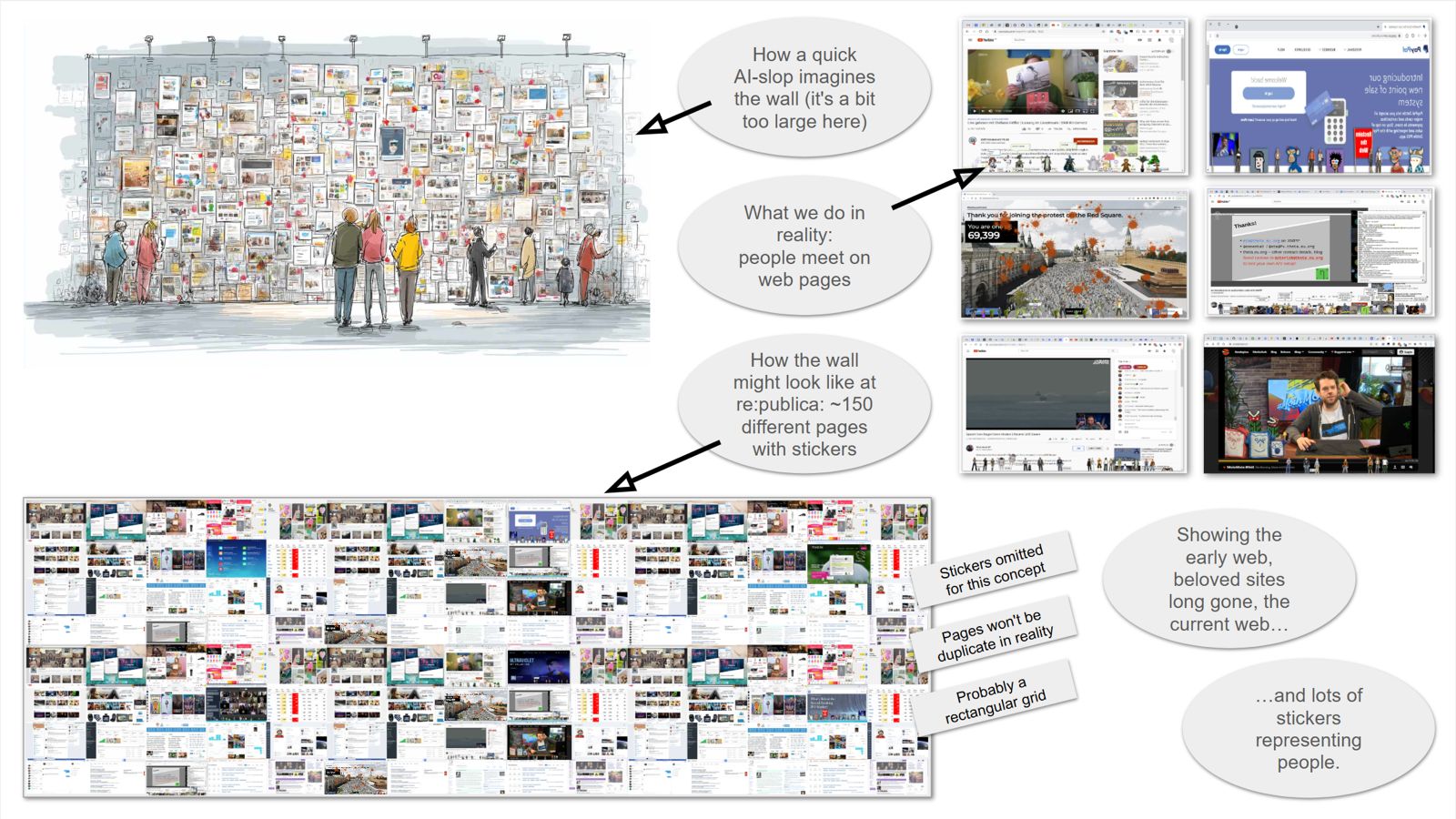
Step up to a 5-meter canvas of Internet history and present: a mosaic of web page screenshots spanning three decades. From early hand-coded homepages, to beloved communities long swallowed by platforms, to the sites still standing today. This is your map of the Internet that matters to you.

Pick a sticker from our collection, or bring your own, and place yourself on the pages that shaped you. The web-zine that opened your mind. The forum where you found peers. The blog that proved you weren't alone. The weird little corner of the web you still visit.

Watch the wall come alive with fellow travelers. Discover clusters forming around virtual places. Find others who refuse to let go of the same digital spaces you cherish. See that behind every URL, there are real people who care.

This isn't just nostalgia, it's a declaration. Every sticker says: "I was here. These ideas still matter."

The exhibit visualizes what we've lost to algorithmic feeds and platform silos: the serendipity of sharing space with strangers who share your interests. It's a physical prototype of an idea we're building online, making people visible on the pages they visit.

Reclaim your web. Leave your mark.

# Project Info

Interaktiv: Yes. We transfer the idea of "Avatars on Browser-Screens" to "People as stickers on a wall of their favorite pages" - and then (sometimes and if people do ask what this is about) we would explain what we really do with a browser extension on computer screens.

The project started during Corona, when we were not supposed to go outside, with idea that we could meet on the Web instead. It then quickly turned into a way to communicate everywhere on the Web without paying by profile data, even on small Web sites. We want to make web pages the streets and places of the Web where you can meet people by chance, meet a friend, encounter new people, because they happen to read the same pages at the same time as you are. You can rally for a cause because you see the other people.

But of course, you can also ignore people. Just like in the real world, you do not chat with all people on the street. Yet, life is much more rich and vivid with all these people and some of them are actually interesting, because you obviously have a shared interest by accessing the same content, when you check out the same product or read the same fringe newspaper everyday.

And then there is our claim of open communication not regulated by social network silos. This rhymes with "die Idee des offenen Netzes […] die Vision, dass Technologie allen gehört – und nicht nur den Mächtigen"

By presenting not just current web pages, but also past ones we want to recall the early Web, which was our Web, when we started our journey like many of you. "An die Anfänge des Web 2.0 und daran, dass wir einmal Spaß hatten an diesem Internet, in dem wir unterschiedlicher Meinung sein konnten und uns trotzdem respektiert haben." In the early days we thought that everyone could be a publisher, every voice might be heard, but then SN silos regulated communication, algorithms select what we see and read. And worse, algorithmic bubbles polarized. We want to turn the wheel back by showing people on Web pages, real people who communicate, not bots, not feeds, not AI-slop, but real live communication between people. Exactly what we do when we go on the street or go to events like re:publica.

Finally (and you might not believe this but) the motto "Die re:publica 2026 lädt dazu ein […] das Netz zurückzuerobern" is exactly our claim: "Reclaim the Web". We mean the entire Web and live interaction between real people. I guess you mean the same.

# Why

Never has re:publica's motto fit better to our project:
Real people, live, everywhere - Reclaim the Web.

About the project behind this exhibit:

We go to re:publica to meet and talk to like minded people.
Why don't we do that on the Web?
There are people on the same page at the same time.
But we do not see them.

weblin.io makes people visible as avatars on Web pages.

It makes every web page a place where people can talk,
enabling communication on the long tail of the Web,
where like minded people meet because they visit the same pages.
A social network without being a Social Media Silo.
A federated social layer that cannot be owned,
because its technology is decentralized as the Web itself,
based in Europe and Open Source.
There is no login required, no profile.
It does not force you to pay by profile data just to talk to people.

We would love to show the idea in a haptic / offline / interactive way.
As a wall of early and current Web pages where people can attach their avatar as sticker,
to show their affiliation with mindsets and ideas represented by these sites.